
Severe burns are traumatic and physically debilitating for patients, who may experience slow healing rates, infection, pain, and hypertrophic scarring during their recovery.
Backed by industry-leading clinical data, Kerecis’ GraftGuide® can optimize your patients’ burn care and recovery. Made of intact fish skin, GraftGuide is clinically proven to accelerate burn wound healing, while reducing complications, length of stay, and scarring.
Kerecis for Burn Management
Accelerate healing & reduce complications [1-3]
Reduce patient length of stay [4,5]
Regenerate organized tissue & help minimize scarring [6-8]
Accelerate Burn Healing & Reduce Complications
Because there is no known risk of disease transfer from North Atlantic cod to humans, Kerecis fish-skin grafts are minimally processed with no harsh chemicals or detergents. This gentle processing preserves the fish skin’s natural structure, porosity, and molecular content, which help promote faster and more effective wound healing.
This has exciting implications for burn patients:
Deep-partial thickness burns treated with Kerecis grafts had significantly faster blood vessel formation, faster integration into the wound bed without increased contraction, and faster wound closure compared to burns treated with fetal bovine dermis.[1]
Faster Blood Vessel Formation Than Fetal Bovine Dermis[1]


With Kerecis’ faster epithelialization and healing, you can potentially avoid a subsequent split-thickness skin graft,[2,3] which can be invasive and painful for your patients.
Kerecis fish-skin grafts also help reduce complications during the burn healing process by acting as a natural bacterial barrier for up to 48-72 hours.[4] To date, no known infection incidents have been reported on the FDA Adverse Event Reporting System (FAERS).
Reduce Patient Length of Stay
With GraftGuide’s efficient application and rapid healing outcomes, hospitals and providers can significantly reduce their patients’ recovery time and length of stay.
A 2024 case series on patients with deep dermal burns found that Kerecis drastically reduced the length of hospitalization by promoting rapid healing with no evidence of infection, avoiding the need for split-thickness skin grafts and additional operations.[5]
By accelerating healing and reducing length of stay, hospitals can achieve significant cost savings,*,[6] while helping your patients get back to doing what they love – faster.
*Cost outcomes are based on results from Lantis et al., 2023, and may not reflect real‑world costs or outcomes in all settings. Individual results may vary, and no specific financial savings are guaranteed.

Graph adapted from Heitzmann et al[7]
Regenerate Organized Skin Tissue
Kerecis’ minimal processing preserves the fish skin’s natural molecular content, which supports organized tissue regeneration and can help minimize scarring.[3,8,9]
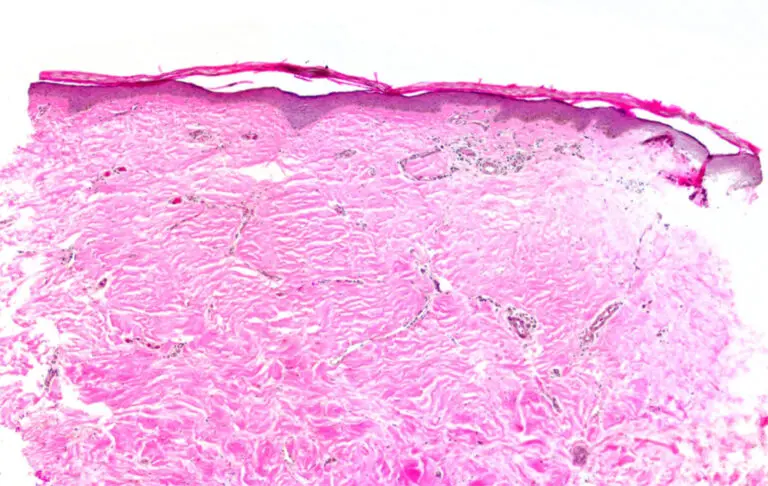
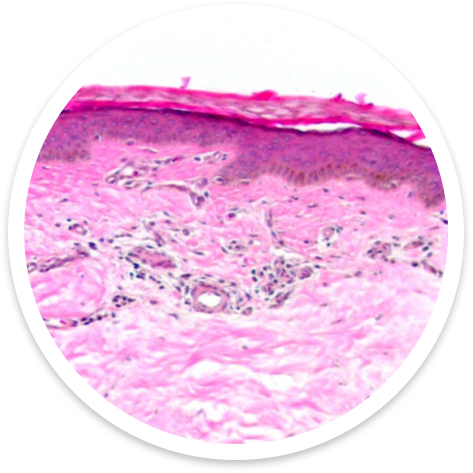
In a 2021 feasibility study, full-thickness injuries treated with Kerecis had similar functional and cosmetic outcomes, including pliability, pigmentation, hydration, and vascularity, as cadaver skin-treated injuries.[9]
One year after treatment, punch biopsies revealed fully regenerated skin with a natural basket-weave pattern, multiple distinct layers, and vascular structures well-distributed.[9]
Organized Tissue Regeneration with Kerecis[9]
Unique Sizes & Variations to Meet Your Burn Care Needs
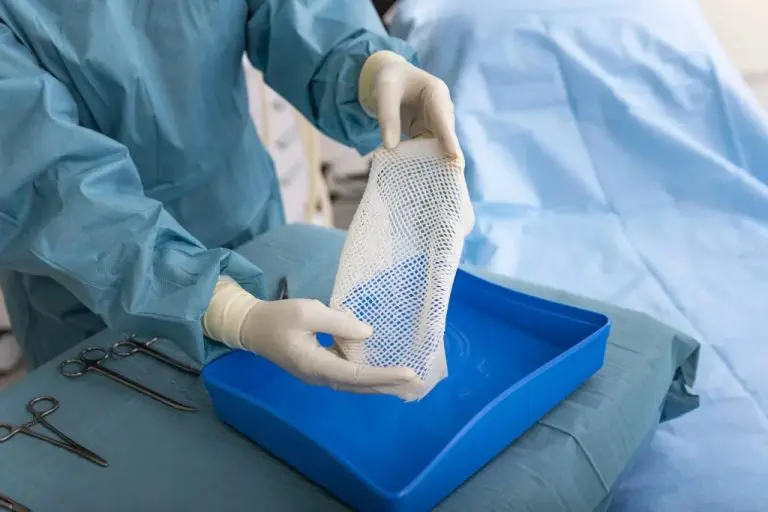
Our GraftGuide portfolio — including our Meshed 2:1 product, which expands to cover larger burns — is designed to help you handle complex burn injuries with greater ease.
Check out our product page for more details.
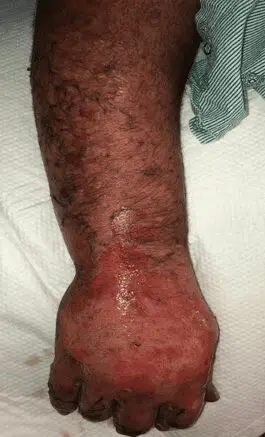
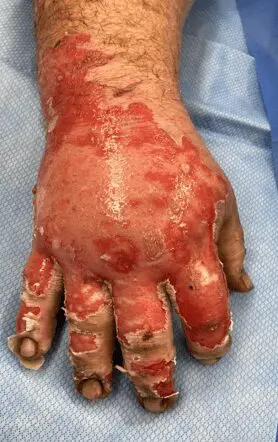
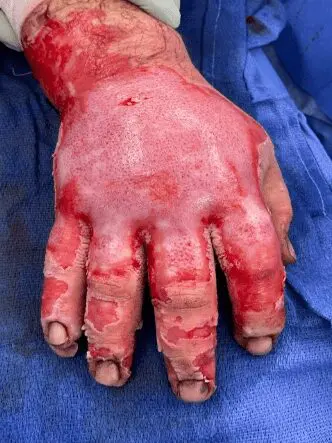
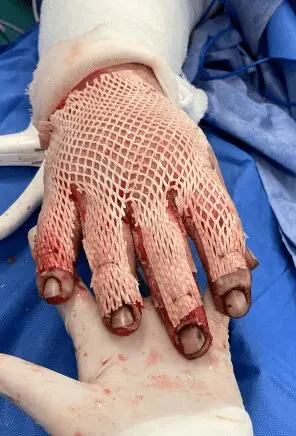
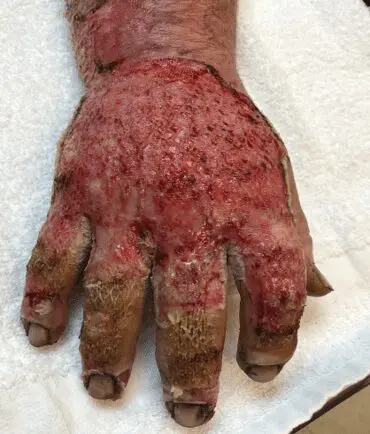
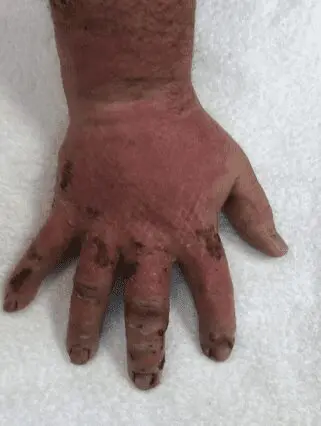
Thermal Hand Burn
Thermal hand burn managed with GraftGuide Mano, with reduced inflammation and no scar contracture.
Deep Partial-Thickness Thermal Burn
Patient History, Initial Treatment
- 39-year-old male
- Presented with 4% total body surface area (TBSA) deep partial-thickness thermal burn
Previous Management
Presented to the burn center on the same day as the injury with no previous treatment reported.
Application
The wound was debrided using dermabrasion, and GraftGuide Mano (Size L) was applied to cover the dorsal aspect of the right hand. The product was secured in place, and a secondary dressing was applied.
Clinical Outcome
Single application of GraftGuide Mano resulted in good secondary intention healing for the patient without the need of autograft. Good functional outcome with no evidence of scar contracture.

See how Kerecis Helped Burn Survivor Pétur Oddsson
Download to Learn More
Need more information?
Important Information
Stone R, Saathoff EC, Larson DA, et al. Accelerated Wound Closure of Deep Partial Thickness Burns with Acellular Fish Skin Graft. Int J Mol Sci. 2021;22(4):1590. doi:10.3390/ijms22041590
Fierro AL, Bridge M, Hijazi N, Youssef G, Lantis JC 2nd. Intact Fish Skin Graft for the Treatment of Burns: Deep Partial Thickness Burns and Beyond. Surg Technol Int. 2025 Jan 16;45:sti45/1836. doi: 10.52198/25.STI.45.WH1836. Epub ahead of print. PMID: 39821348.
Wallner, C. et al. (2022). The use of intact fish skin as a novel treatment method for deep dermal burns following enzymatic debridement: A retrospective case-control study. European Burn Journal, 3(1), 43–55.
Magnusson S, et al. Regenerative and Antibacterial Properties of Acellular Fish Skin Grafts and Human Amnion/Chorion Membrane: Implications for Tissue Preservation in Combat Casualty Care. Mil Med. 2017;182(S1):383-388. doi:10.7205/ MILMED-D-16-00142
Stauback R et al. The Use of Fish Skin Grafts in Children as a New Treatment of Deep Dermal Burns—Case Series with Follow-Up after 2 Years and Measurement of Elasticity as an Objective Scar Evaluation,J Clin Med. 2024 Apr 19;13(8):2389. doi: 10.3390/jcm13082389
Lantis II JC, et al. Final efficacy and cost analysis of a fish skin graft vs standard of care in the management of chronic diabetic foot ulcers: a prospective, multicenter, randomized controlled clinical trial. Wounds. 2023;35(4):71-79. doi:10.25270/wnds/22094
Heitzmann et al. Accelerated wound healing of enzymatically debrided deep dermal burn wounds after the use of fish skin in comparison to Suprathel. Burns. 2025 June. doi: 10.1016/j.burns.2025.107471. Both products N = 22. p = 0.000007.
Yue B. Biology of the Extracellular Matrix: An Overview. J Glaucoma. 2014;23:S20-S23. doi:10.1097/IJG.0000000000000108.
Shupp J, McLawhorn M, Moffatt L. Fish Skin Compared to Cadaver Skin as a Temporary Coverage and Wound Bed Preparation for Full Thickness Burns: An Early Feasibility Trial. J Burn Care Res. 42:S124-S124. doi:doi:10.1093/jbcr/irab032.201