
Chronic, hard-to-heal venous leg ulcers (VLUs) are devastating for patients who risk losing their mobility, missing work, or withdrawing from social activities.
Backed by industry-leading clinical data, MariGen is designed to help you manage your patients’ toughest VLUs and promote faster wound closure. With its compression-compatible design, available large surface area coverage, and natural components that help expedite the healing process, MariGen has you covered for hard-to-heal VLUs.
MariGen for VLUs
Clinically effective and favorably priced
Compression compatible and available in a wide range of sizes
Backed by comprehensive reimbursement support
Clinically Effective, Favorably Priced
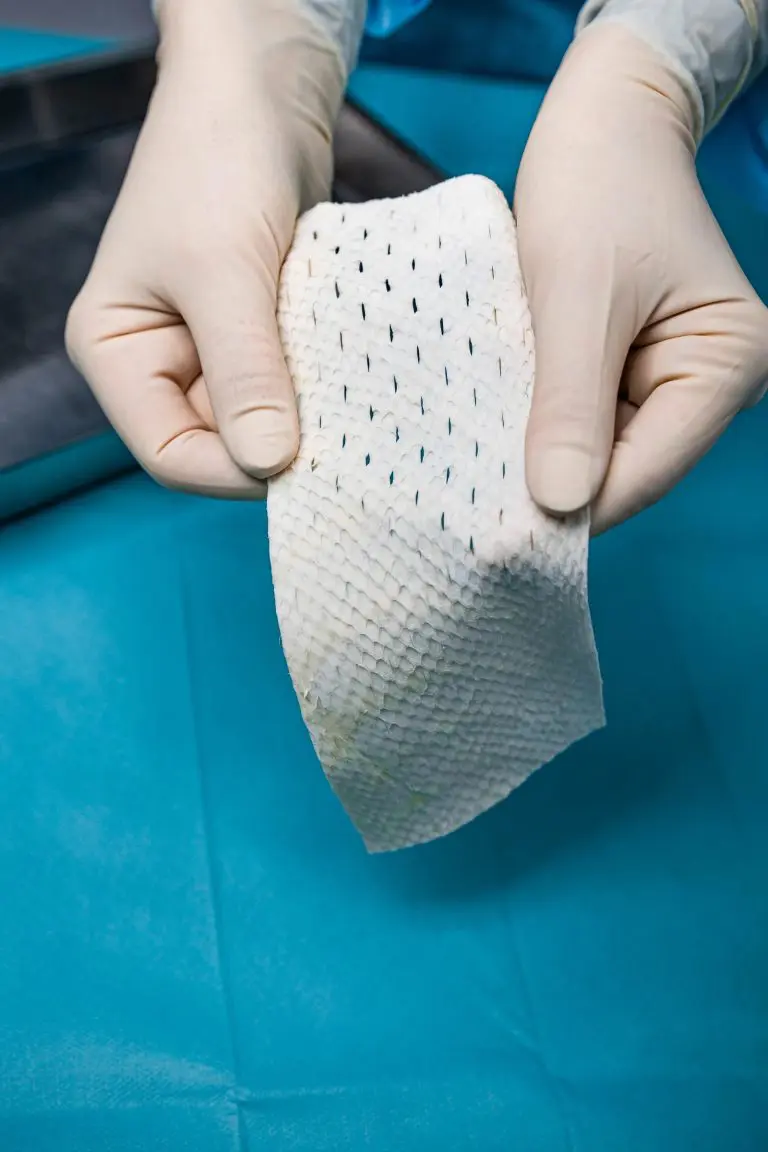
Because there is no known risk of disease transfer from North-Atlantic cod to humans, Kerecis fish-skin grafts are minimally processed with no harsh chemicals or detergents. This gentle processing preserves the fish skin’s natural structure,[1] porosity,[2,3] and natural components,[2,4] which help promote faster and more effective wound healing.
Our products’ clinical efficacy is backed by 100+ peer-reviewed publications, including an ongoing VLU RCT, that demonstrate our ability to fast-track wound healing and close complex ulcers. Check out some of our powerful evidence below:
Natural Components Help Expedite the Healing Process
- Kerecis’ minimal processing preserves the fish skin’s extracellular matrix (ECM) components, [2] which are often removed during the harsher processing of mammalian tissue replacement products. [5]
- For example, Kerecis grafts have more natural components than bovine collagen tissue replacement products. [2]
- Together, these ECM components play key roles in rapidly facilitating angiogenesis, cell migration, and maintaining a bacterial barrier. [6,7]
Clinically Proven to Close Complex Ulcers
- Patients with hard-to-heal lower extremity chronic ulcers saw a 40% decrease in wound surface area and a 48% decrease in wound depth after five weekly applications of Kerecis and secondary dressing. [8]
- An interim analysis of the THOR trial demonstrates a strong positive trend in using Kerecis to treat nonhealing VLUs: a 25.9% absolute gain in wound closure rates over standard of care alone (47.6% vs 21.7%).* [9]
*Interim analysis, not statistically significant.

Kerecis decreases wound surface area by 40% in 5 weeks [8]
Complementing Kerecis’ strong clinical evidence and patient outcomes, our product prices remain favorable compared to current CMS reimbursement levels. The average cost of our MariGen products fall well below the flat rate of $127.14 per cm2 for hospital outpatient departments, ambulatory surgical centers, physician offices, and home health providers.
Compression Compatible and Available in a Wide Range of Sizes
| Variation Name | Product Size | Coverage (cm²/Unit) |
|---|---|---|
| Standard | 3x3.5cm | 10.5 cm² |
| Standard | 3 x 7 cm | 21 cm² |
| Standard | 5 x 7 cm | 35 cm² |
| Standard | 7 x 7 cm | 49 cm² |
| Standard | 7 x 10 cm | 70 cm² |
| Fenestrated | 3 x 3.5 cm | 11 cm² |
| Fenestrated | 3 x 7 cm | 21 cm² |
| Fenestrated | 7 x 10 cm | 70 cm² |
| Micro | 8 cm² | 8 |
| Micro | 19 cm² | 19 |
| Micro | 38 cm² | 38 |
| Meshed 2:1 | 7 x 8 cm | up to 101 cm² |
Illustrative sizes shown, please contact us for complete product availability.
Backed by Comprehensive Reimbursement Support
Proper documentation is key to ensuring reimbursement for skin substitutes. Kerecis’ field reimbursement team and benefits investigators are available to provide real-time guidance if you need support: reach out anytime to reimbursement@kerecis.com.
Our AI-powered digital platform, Kerecis Current, also provides user-friendly coding and reimbursement guidance to help you align with CMS requirements and streamline your claims and documentation for VLUs. If you have questions, email: current@kerecis.com.
With these streamlined processes and comprehensive reimbursement support, you can focus on what matters most: your patients’ care.
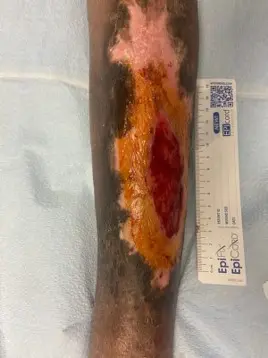
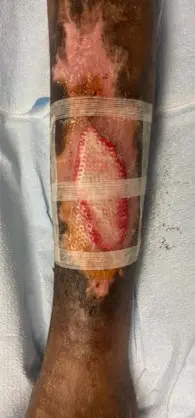
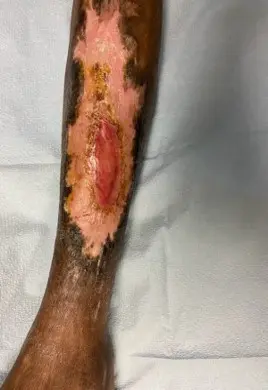
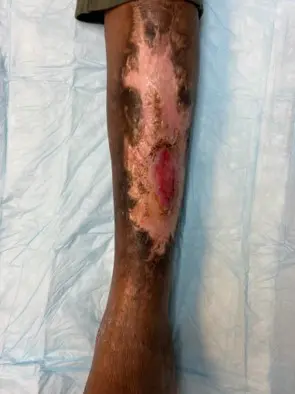
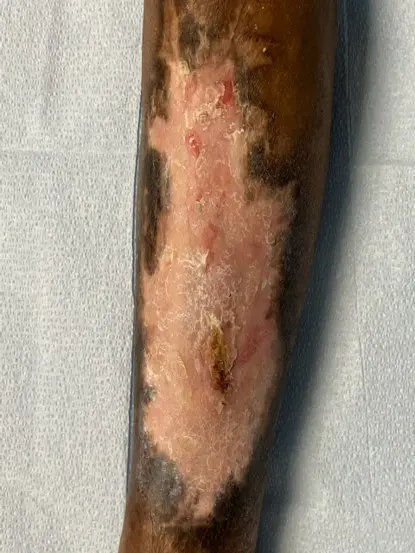
VLU Case Study
Venous Leg Ulcer
Case Description
Venous leg ulcer on patient’s lower extremity.
Wound was 6-months-old at first application.
Applications: 10

Download Evidence Summary
Need more information?
Important Information
Magnusson S, Baldursson BT, Kjartansson H, Rolfsson O, Sigurjonsson GF. Regenerative and Antibacterial Properties of Acellular Fish Skin Grafts and Human Amnion/Chorion Membrane: Implica- tions for Tissue Preservation in Combat Casualty Care. Mil Med. 2017;182(S1):383-388. doi:10.7205/ MILMED-D-16-00142
Yoon J, Dogeon Yoon, Lee H, et al. Wound healing ability of acellular fish skin
and bovine collagen grafts for split-thickness donor sites in burn patients:
Characterization of acellular grafts and clinical application. Int J Biol Macromol.
2022;205:452-461. doi:10.1016/j.ijbiomac.2022.02.055
Wang Y, Xu R, He W, et al. Three-Dimensional Histological Structures of the Human Dermis. Tissue Eng Part C Methods. 2015;21(9):932-944.
doi:10.1089/ten.tec.2014.0578
Kotronoulas A, Jónasdóttir HS, Sigurðardóttir RS, Halldórsson S, Haraldsson
GG, Rolfsson Ó. Wound healing grafts: Omega-3 fatty acid lipid content
differentiates the lipid profiles of acellular Atlantic cod skin from traditional dermal
substitutes. J Tissue Eng Regen Med. 2020;14(3):441-451. doi:10.1002/
term.3005
Crapo PM, Gilbert TW, Badylak SF. An overview of tissue and whole organ
decellularization processes. Biomaterials. 2011;32(12):3233-3243. doi:10.1016/j.
biomaterials.2011.01.057
Jiménez-Gastélum GR, Aguilar-Medina EM, Soto-Sainz E, Ramos-Payán R,
Silva-Benítez EL. Antimicrobial Properties of Extracellular Matrix Scaffolds for Tissue Engineering. BioMed Res Int. 2019;2019:1-7. doi:10.1155/2019/964145613
Yue B. Biology of the Extracellular Matrix: An Overview. J Glaucoma. 2014;23:S20-S23. doi:10.1097/IJG.0000000000000108
Yang CK, et al. A prospective, post-market, compassionate clinical evaluation of
a novel acellular fish-skin graft which contains omega-3 fatty acids for the closure
of hard-to-heal lower extremity chronic ulcers. Wounds, 2016.
Serena, et al. Evaluation of intact fish skin grafts plus standard care in thetreatment of venous leg ulcers: an interim analysis of the THOR
trial. International Journal of Tissue Repair, 2025.